tBrief #11 – TRANSPARENCY IN DEVELOPMENT FINANCE FOR MARINE FISHERIES: An impossible task?

In our latest tBrief, we explore the transparency of development finance to the fisheries sector and explain why improving it is both important and difficult.
Development finance does not feature as prominently in global discussions about raising transparency in the fisheries sector as it should. The strongest associations made between transparency and fisheries relate to the activities of fishing vessels, the traceability of fish products and spending on subsidies. However, every year, billions of dollars are being spent on developing the fishing sector and improving the conservation of fish populations and marine habitats. Many countries have become highly dependent on these financial flows, although the limited literature exploring the outcomes of development aid projects is not particularly positive. This is even something that the World Bank, the largest single source of aid to fisheries, has recognised.
While the impact of development finance for fisheries remains disputed, what is clear is that transparency is vital for public engagement in the design, implementation and review of development finance projects. The issue will become more urgent as the flow of finance for fisheries and marine conservation is set to increase with international pledges on climate and biodiversity.
This tBrief argues that improving transparency in development finance is a daunting challenge. It has been a priority for many development agencies for decades, resulting in some impressive achievements. Yet the ambitious principles set for development finance have not been met, and the performance of donors and governments has been inconsistent.
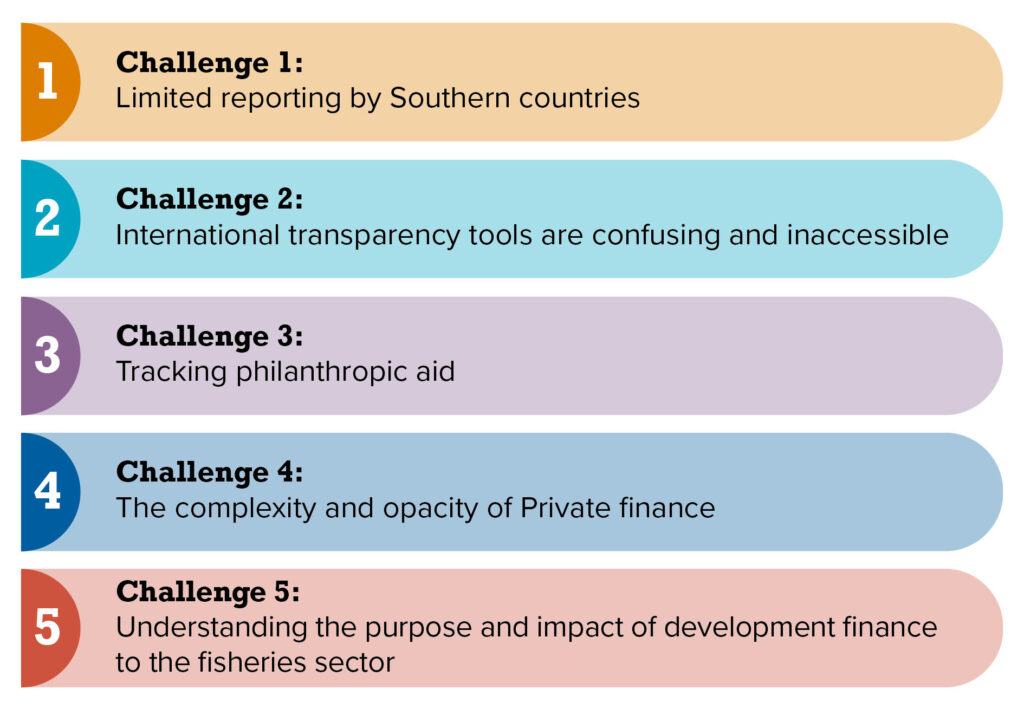
Despite several international databases established to track aid flows, none provides a complete picture, and none is particularly easy to use. In fact, data from one database, such as the Creditor Reporting System managed by the OECD, provides a very different view of aid flows than data from another, such as the D-Portal managed by the International Aid Transparency Initiative.
As a result, there is no reliable figure for how much aid goes to the fisheries sector each year; estimates of government and international organisation funding range from 500 million to 1 billion dollars. That figure jumps dramatically when aid spending on marine conservation is included, and even more so when aquaculture is factored in. But because of incomplete reporting, no one knows precisely what the true figure is.
While most donor agencies have committed to publishing extensive project documentation, including information on outcomes, few do so regularly. As a result, there is no international understanding of what aid to the fisheries sector aims to achieve: how much is intended to support small-scale fisheries? How much is used to fight illegal fishing? Or how much ends up supporting industrial fishing interests?
According to the OECD, Japan has been, by far, the largest bilateral donor to developing countries’ fisheries sectors for decades, but very little is known about Japan’s objectives. European member states have a group to discuss aid coordination in the fisheries sector, but they do not publish the outcomes of their meetings either.
Improving transparency on aid flows is partly a technical challenge. Among international organisations, such as the Development Assistance Committee (an exclusive club of industrialised countries established in the 1960s, now with 32 members), there is a confusing, constantly changing approach to measuring financial flows and to defining what is and what is not development aid. Much of the political sensitivity surrounding this stems from accounting for loans rather than grants. Adding to the confusion is the United Nations’ new metric for development assistance, called ‘Total Official Support for Sustainable Development’. It is a global initiative to track development finance for the Sustainable Development Goals, but it measures aid differently from the DAC.
Yet what makes transparency even more challenging is the evolving landscape of development finance, including the phenomenal growth of philanthropy and the convergence of traditional aid with private finance.
Regarding philanthropy, research suggests that over the past decade, about a billion dollars has been donated by prominent philanthropic foundations to ocean conservation, with much of it going to scientific research and the management of marine protected areas. In some Southern countries, philanthropic aid for marine conservation, particularly from the US, is far greater than government spending, raising questions about how the rise of philanthropy affects the control of public resources. Yet the biggest philanthropic donors in marine conservation publish very little about their grants, and many seem to devote little attention to public participation and accountability.
However, perhaps the most complex and opaque aspect of development finance is the emergence of innovative financial instruments that blend traditional aid with private capital, such as blue bonds and debt-for-ocean swaps. While many believe that a move to private finance is vital for closing a funding gap for fisheries and marine conservation, international standards and reporting systems to achieve transparency on these transactions are inadequate.
In this context, our latest tBrief sets the stage for an important dimension of the FiTI Standard: the requirement that countries collate and publish comprehensive information on the development finance mobilised by their governments for fisheries and marine conservation, including contracts and evaluation documents. Our new Standard makes it clear that this extends to the money mobilised by governments from philanthropists and the private sector.
It is hoped that such information will inspire people to debate the purpose of development finance, who benefits from it, and how it impacts the governance of marine resources.
We hope that you enjoy reading this tBrief. If you have any comments, questions or suggestions, please contact us.
You can download this tBrief in the following four languages:
This publication is funded by the Gordon and Betty Moore Foundation.
Interested in learning more? Past editions can be found on our tBriefs page.