FiTI’s latest TAKING STOCK assessment shows importance of fisheries transparency for public accountability in the Pacific
Transparency in fisheries governance has often been framed around illegal fishing or fighting corruption. These are legitimate and important goals. However, they reflect a particular, limited conception of what fisheries transparency is for – one focused primarily on detecting and deterring wrongdoing.
Our latest TAKING STOCK assessment, which examines three countries in the Pacific region – Kiribati, the Marshall Islands and Papua New Guinea – takes a different approach. It considers transparency as a condition for citizens to participate meaningfully in government decision-making. We believe this is a unique and valuable way to approach transparency in fisheries management.
The findings of our assessment show that all three countries have recognised the importance of transparency and have taken meaningful steps to inform the public about their fisheries. However, across a range of thematic areas, significant transparency deficits remain, and in several cases the deficit begins with the policy framework itself: objectives stated without a theory of change, targets set without a baseline, and commitments made in areas where no data collection mechanism exists.
What are national priorities and targets in the fisheries sector of Kiribati, the Marshall Islands and Papua New Guinea?
The assessment of the three Pacific Island states is based on the FiTI Standard, updated in 2026 following a two-year global multi-stakeholder process. One of the most consequential changes agreed to in the Standard requires national authorities to publish a succinct, plain-language summary of their fisheries objectives and targets. And although simple in concept, in our experience, governments often struggle to articulate their national objectives in the fisheries sector, and many lack specific targets or measures for monitoring success. Without such information, stakeholders will find it difficult to address key questions about their country’s fisheries sectors, such as:
- Are there issues of policy incoherence, for example where the government has issued multiple objectives that conflict with one another?
- Are there gaps in the policy frameworks, for example regarding coastal fisheries?
- How comprehensive are targets for national objectives, in particular regarding government activities and their desired outcomes?
- What information is publicly available to allow citizens and stakeholders to monitor whether those objectives and targets are being met?
Our assessment shows that answering these questions is complex. In fact, across all three countries, we found detailed policy documents covering many dimensions of fisheries management – from revenue maximisation to protecting food security, from growing production to protecting threatened species and habitats, from gender to climate breakdown. However, none of the countries had produced the kind of consolidated, plain-language summary advocated for by the Standard. Each country also lacks clear targets for important policy objectives.
Such a fragmented policy landscape is not unusual — fisheries policy tends to develop incrementally, across instruments, agencies, and over time, responding to changing conditions, new scientific understanding, donor priorities, and international commitments.
However, a fragmented and incomplete policy landscape is a fundamental barrier to public accountability: where citizens cannot easily understand what their government is trying to achieve in the fisheries sector, the accountability relationship between government and citizens is weakened. Those seeking to understand national objectives in Kiribati, the Marshall Islands and Papua New Guinea must find and read 20, 13, and 16 documents respectively, produced over decades by different agencies, many of which have uncertain status.
To facilitate public understanding, this report provides a working summary of each country’s policy landscape, organised from the highest-level national policy documents down to fishery-specific management plans.
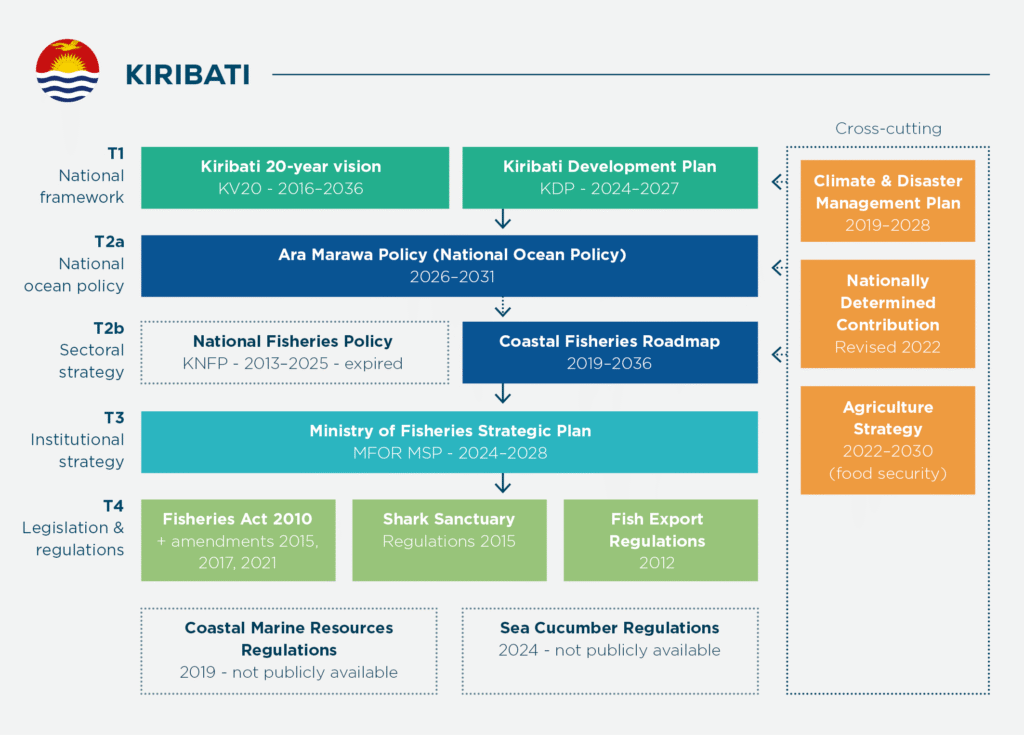
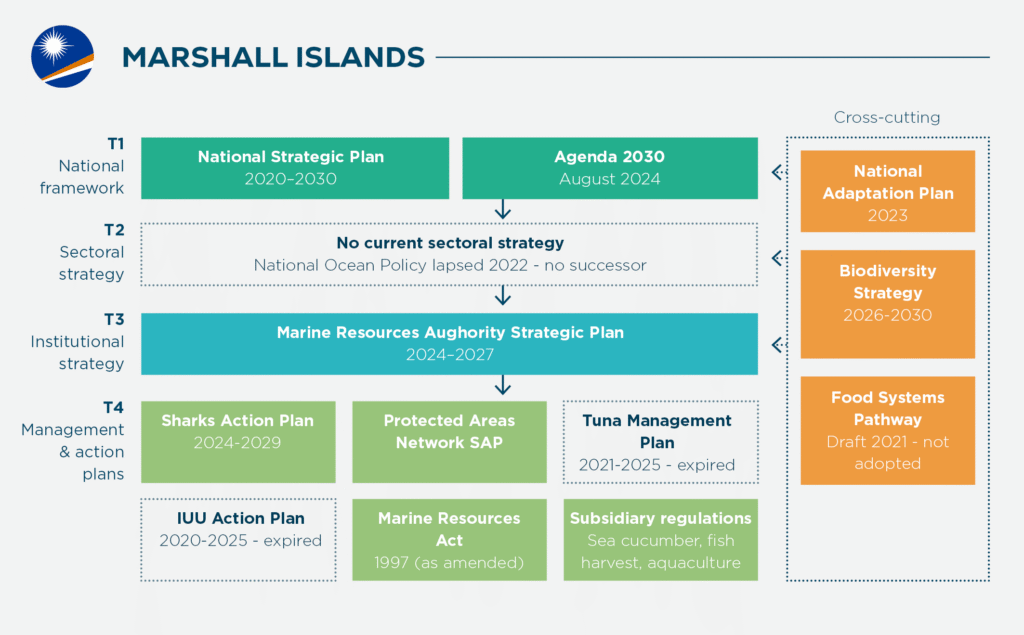
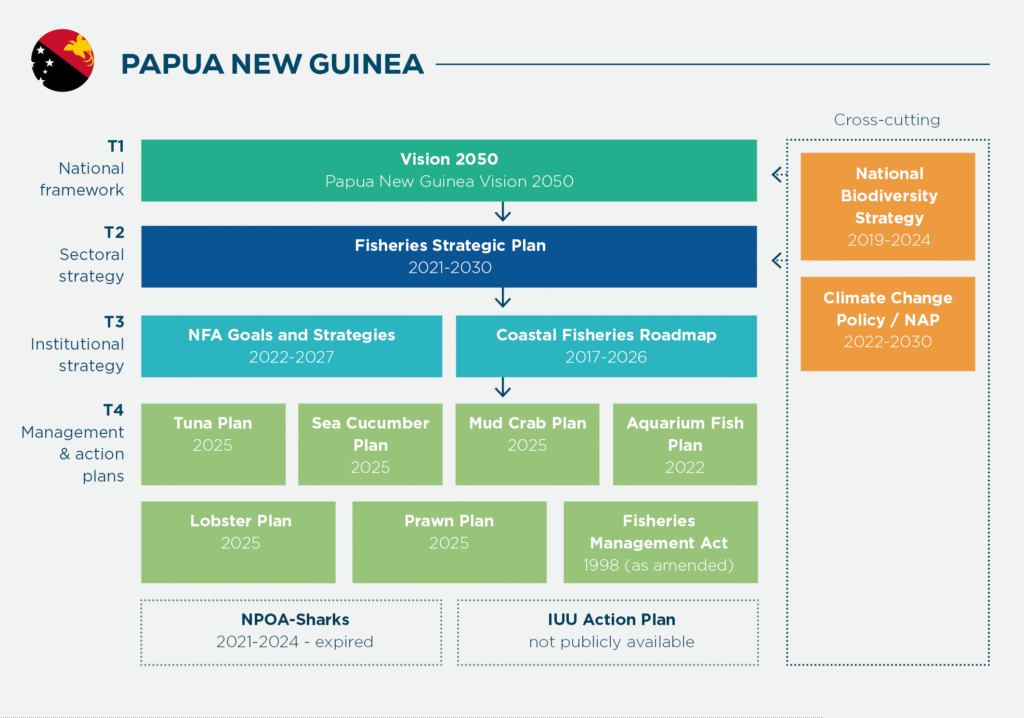
Approaching transparency from such a policy framework point-of-view makes it more relevant to national priorities and, most importantly, it clearly demonstrates why transparency matters.
Are there issues of policy incoherence?
Mapping national policy documents in each of the three Pacific Islands highlighted some potential areas of policy tensions. Again, this is not uncommon, as fisheries is a sector where governments are simultaneously managing an ecological resource, a national revenue stream, a food supply system and a source of livelihoods. For example, our assessment shows a tension between the objectives of revenue maximisation and reducing fishing impacts on fish populations and marine habitats. Specifically, we identified possible divergence between national commitments to expand marine protected areas and the goal of increasing catches and profitability in the fishing industry. Similarly, across all three countries, we encountered policy objectives for export maximisation alongside policies to enhance fisheries for national food security. Some ambitious targets for growth in the fisheries sector are also contradicted by national projections on the impacts of climate breakdown.
It is important to note that perfect policy coherence is unlikely to ever be achieved, but the process of identifying tensions provides the foundation for improving how fisheries are managed and for whom.
Are there gaps in the policy frameworks?
Not surprisingly, across all three countries, offshore tuna dominates the policy landscape in terms of document density, institutional attention and data infrastructure. By contrast, coastal fisheries — which support the majority of people engaged in fishing and provide the primary protein source for most communities — receive thinner, older and less operational frameworks. But beyond this structural imbalance, several gaps are significant enough to warrant national stakeholder attention:
- In all three countries, gender equity is stated as a guiding principle in fisheries policy, yet no subsequent instrument provides guidance on what this means in practice.
- No country has articulated a public rationale for how the substantial public revenues should be distributed: between current spending and intergenerational savings, between national budgets and fisheries management reinvestment, or between offshore and coastal communities.
- All three governments state food security as a core fisheries objective, yet none have published a policy instrument that addresses supply adequacy, affordability or access for food-insecure groups at the national level.
How comprehensive are targets for national objectives?
We found that some national objectives are well articulated, but little information is collated and published to show progress toward those objectives. Three examples illustrate this:
- Each country publishes policy objectives for improving the livelihoods of people engaged in fisheries, including women in the post-harvest sector. None collate and publish information on employment in the fishing and post-harvest sector, or information on wages and incomes.
- All countries aim to sustainably manage fish populations. None publish scientific assessments of the health of coastal fish populations.
- Combating illegal fishing is a priority for national fisheries management, typically framed as zero tolerance. None of the countries publishes information on fines and penalties issued to companies in the sector.
Furthermore, across the three countries, some policy objectives are stated without a publicly articulated theory of change. Governments can explain why an objective matters but not what specific management choices they will take to achieve it. This manifests quite evidently in coastal fisheries: all three countries have a high-level commitment to sustainability, but it is often not clear which strategies they intend to adopt to achieve this across their fishing sectors.
What have we learned from this assessment in terms of fisheries transparency?
Our assessment shows that these three Pacific Island States present complex and reasonably comprehensive policy frameworks. We also argue that the above-mentioned shortcomings and tensions are common worldwide. However, when it comes to fisheries transparency, the most important finding from this report is that the national policy frameworks in each of these countries, to varying degrees, lack public access to information.
But, as our detailed assessment in Part 3 of the report shows, the primary transparency deficit is the absence of information. This challenges simplistic narratives about transparency that equate opacity with deliberate concealment. The more pervasive finding from this report is that governments have identified objectives and targets in areas where they currently are not producing the relevant information. For example, stock assessments for coastal fisheries require scientific capacity and resource-intensive fieldwork that small island states lack.
At the same time, it is important to recognise that a failure to collate information is not always simply a matter of limited resources. Household income and expenditure surveys have been conducted in all three countries, yet the ILO employment categories used in those surveys collapse agriculture, forestry and fishing into a single unit. This categorisation may be defensible for large continental economies but renders fishing analytically invisible in small island states where fisheries play such an important role for employment and social life.
Nevertheless, our report also identified cases of deliberate non-disclosure. In all three countries, fee schedules for fishing access agreements are treated as commercially sensitive and not published. Vessel registries are unavailable. In the Marshall Islands, a revenue dashboard exists but is restricted to authorised users. Information on quota allocations in the sea-cucumber fisheries is not published. All three countries commit formally to public ownership of fisheries resources and equitable benefit sharing. However, those stated values sit in direct tension with the confidentiality practices surrounding the commercial transactions through which access to publicly owned resources is actually granted.
Furthermore, there are several areas where data on national fisheries can only be found in regional or international reports or websites. This is a strength of the Pacific region: over the past decade or so, several regional organisations have generated detailed information on fisheries in countries across the region. However, the FiTI Standard views this as a suboptimal approach if the information remains available only at this level, because it is much more likely to be overlooked in national policy documents and debates.
Perhaps the sharpest finding concerns what the report calls the learning deficit. Across all three countries, a review of how well fisheries are being managed is not being presented. Annual reports are activity logs: they record observer deployments, patrol operations, regulations drafted and meetings held. They do not systematically ask whether those activities are producing the outcomes committed to by the policy framework. An example comes from the issue of shark bycatch.
The Marshall Islands’ Sharks Action Plan commits to reducing shark bycatch to near zero through 22 time-bound actions. However, data published by the Western and Central Pacific Fisheries Commission shows incidental catches of silky sharks by the country’s chartered longline fleet rose from 10 tonnes in 2020 to 630 tonnes in 2024. That data is publicly accessible, but only through a regional technical document. No national publication includes this or connects it to the government’s own conservation commitments. It is hard to know if this data reveals an actual increase in shark bycatch, or changes in the way that vessels report data.
Overall, our report shows that the information that matters most for public accountability varies with what a government has prioritised, what its fisheries look like, and who depends on them. In three Pacific Island states, the most consequential transparency gaps are not necessarily the ones that attract the most attention from international advocacy campaigns. They are the gaps between what governments have set out to achieve, and the information needed to assess whether they are succeeding.
However, the value of this TAKING STOCK assessment lies not only in what it reveals about the three countries, but also in demonstrating a different way to think about transparency. What are governments trying to achieve through fisheries management, and how far have they progressed in meeting these objectives? This report, therefore, offers a constructive evaluation of government transparency to facilitate public debate on what improvements could be made in Kiribati, the Marshall Islands and Papua New Guinea.
This ‘TAKING STOCK: Assessment of fisheries policy transparency for Kiribati, the Marshall Islands and Papua New Guinea’ has been funded by the German Federal Ministry for Economic Cooperation and Development (BMZ).
Complementary to this report is a dedicated webpage with a detailed overview of the national objectives and their associated targets in each of the three countries (as of August 2026): https://fiti.global/taking-stock/pacific_fisheriespolicytransparency.